
Simplify Your Compliance Today
Effortless online compliance services tailored for your business needs
Rated 4.8/5
★★★★★
What is Barcode?
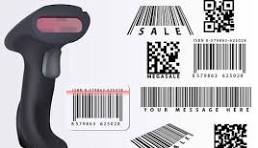
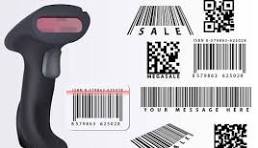
Barcodes are vertical lines representation that can be scanned electronically to fetch the product details faster.
Barcode is used to encode the product details instantly such as product numbers, serial numbers, and batch numbers. A barcode on product plays a vital role in the supply chain, enabling all participant like Manufacturers, transporter, wholesaler to identify products easily.
In addition to that, a barcode on products plays a vital role in a supply chain, supermarkets, transportation, hospitals, and fast-moving retails chains.
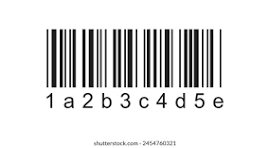
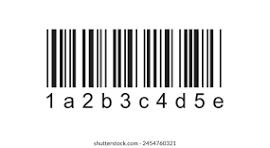
EAN-13 is the most commonly used type of barcode that has 13 numeric digits. UPC-A barcode is a superset of 12 numeric digits.
Is Barcode registration compulsory?
Barcode registration is not a government mandatory requirement. A retail barcode will work fine even without registration because stores enter the barcode number and link it to their billing or inventory software on an individual basis.
Benefits of international barcode registration
We do not just provide barcode ownership to you. We ensure registration of EAN 13 & UPC barcode on an international barcode database along with product details.
Barcode registration enables visibility on google search for the barcode number affix on the product. On registration, Barcode scanning will return product information from an international database to the readers online.
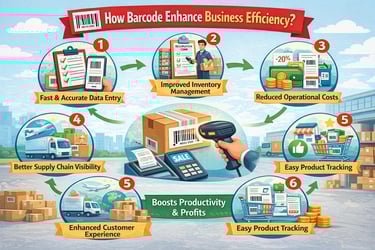
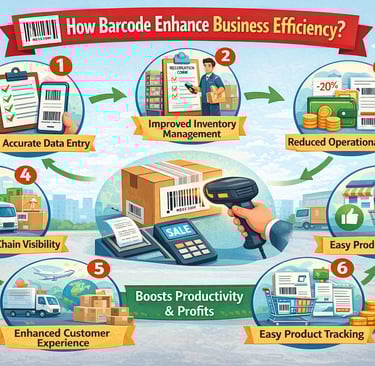
How Barcode enhance business efficiency?
1. Eliminates Error
Barcode removes the chance of human errors. A barcode scan is fast and accurate and takes much less time than manual data entry.
2. Cost-effective & convenient
Barcodes are really cost effective, easy to obtain and print, moreover they can also be customized.
3. Detailed information
The Barcode contains all the relevant details of the product such as product numbers, serial numbers, and batch numbers and also ensures the genuineness of the product.
4. Inventory control
Barcode registration saves the time of all supply chain Participants and makes easy for the product to move anywhere in lesser time.
5. Saves time
Barcode registration saves a lot of time. All anyone just needs to do is scan the barcode affixed on the product and refer to the details there of.
6. Better decision making
The consumers rely on Barcode scanned product information which is more accurate. This leads to immediate decision-making.
Free Barcode generator Vs GS1 Barcode
There are various free online tools available to generate barcodes.
Manufacturers and packagers spend thousands of rupees printing barcodes on product packaging. Generally, big retail chains such as Walmart, Big Bazaar, Max Fashion, Home Center, Aditya Birla Retail, Shoppers Stop, etc do not accept barcodes except GS1.
Product rejection due to free barcodes may lead to a big loss by reprinting product packages again with legitimate barcodes.
Pros & Cons of Free Barcodes
Pros - It's Free!
Cons
. Big retail chains do not accept Free barcodes.
. Barcode meant for quick scanning. Free one carries poor quality and generally, compromise with scan capability.
. No guarantee of a unique barcode number. Free tool may generate the same barcode to anyone.
. No barcode ownership.
Types of barcode
EAN-130 International Article Number previously called European Article Number. EAN-13 is the 13-digit barcode generally used in Europe, India and other nations.
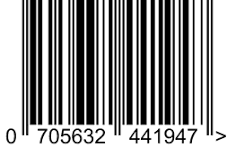
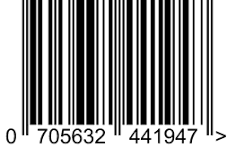
UPC-A Universal Product Code or UPC-A is a 12-digit barcode generally used in US, Canada, UK, Australia and New Zealand.
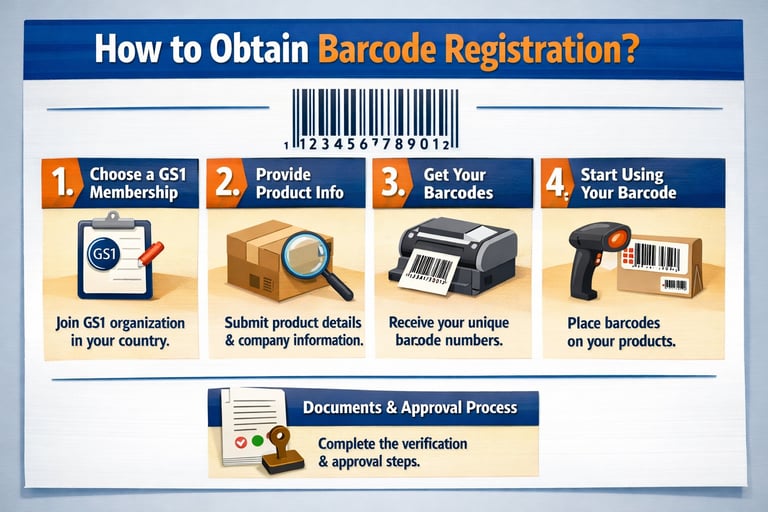
How to obtain barcode registration?
1. Upload the required documents & business details to our web portal.
2. Consult our business advisor about a product for which seeking Barcode registration.
3. Choose Package and Pay online with different payments modes available
4. On placing an order, your application shall be assigned to one of our dedicated professional.
5. After documents & information scrutiny, our team will file an application for product barcode registration.
6. On successful barcode registration, we will provide barcodes and certificate.
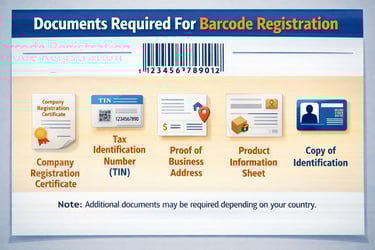
Documents Required For Barcode registration
Company Pan Card A copy of PAN Card of the company is required as Proof of authentication of the business entity.
Business Registration Proof Such as GST registration , partnership deed , certificate of incorporation , shop establishment certificate , FSSAI license, etc.
Canceled Cheque A Cancelled Cheque is mandatory to be submitted for verifying bank account details.
Audited Financial Statement In order to ascertain the previous year's annual turnover of the business entity, last year's Audited Financial Statement is necessary.
Product Details Such as product number, serial number, batch number, MRP of the product.
Company Letterhead Letter for requesting the allotment of barcode on the company letterhead must be submitted.
Types of GS1 barcode registration
There are majorly 4 types of Barcodes and all these barcodes have capability to hold different data.
The GS1 a not-for-profit, international organization develops and maintains barcodes and these barcodes can be classified as:
GS1 EAN/UPC FAMILY BARCODES
GS1 Barcodes also known as GTINs (Global Trade Item Numbers) or EAN enable you to market your products through contemporary trade retail channels.
These are the oldest and most commonly utilized of all the GS1 barcodes
GS1 DATABAR FAMILY BARCODES
DataBar barcodes are frequently used to label fresh foods.
They can store information such as the product's batch number or expiration date, as well as other details used at the time of purchase, such as the item's weight.
GS1 1D BARCODES
GS1-128 and ITF-14 are 1D barcodes that are very adaptable barcodes. GS1 1D Barcodes make it possible to track items across worldwide supply chains.
The GS1-128 barcode can contain any of the GS1 identification keys, as well as other data like serial numbers and expiration dates.
The ITF-14 barcode, on the other hand, can only store the Global Trade Item Number (GTIN) and is ideal for printing on corrugated materials.
GS1 2D BARCODES
2D barcodes are square or rectangular in shape and consist of many tiny dots. They can store a large amount of information.
Furthermore, GS1 2D Barcodes remain readable even when printed small or imprinted onto a product.
These barcodes are used in a variety of industries, including manufacturing, warehousing, logistics, and healthcare.
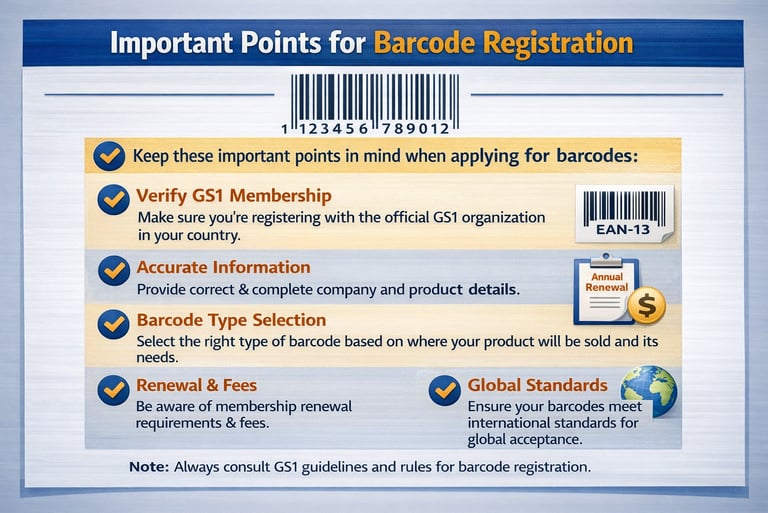
Important Points for Barcode Registration
1. The Barcode Registration process typically takes 7-10 business days after submitting the required registration form, necessary documents, and fee payment.
2. Barcode numbers can only be applied for by brand owners. In the event that you require barcodes for different brand products, you must submit separate Barcode Registration applications for each company/brand.
3. It is possible to apply for GS1 barcode numbers in increments of 100, 1,000, 10,000, or 100,000. However, it is important to note that the number of barcode numbers applied for cannot be modified at a later time.
4. Prior to submitting your barcode number registration application, it is recommended that you take into consideration the total number of SKUs/product variants that you have. Also, consider future additions that may be made within the next several years.
5. If the barcode numbers allocated to your organization are used up, you must submit a new barcode registration application to obtain additional barcode numbers.
6. In some cases, additional company documentation may be necessary before GS1 barcode numbers can be allocated.
7. To ensure continued use of your barcode numbers, it is important to renew your barcode registration prior to the expiration date.


Your trusted partner for business registration, legal, and tax compliance in India.
Important Links
About us
Careers
Corporate Office
B-23, Krishna Plaza, Second floor, Sarai Khwaja, Faridabad 121003
+91 9870142701
Connect.chartered24@gmail.com
© 2026 Chartered24
Client Testimonials
ICAI
ICSI
ICWI
GST
Income Tax
MCA
Registration
EXPERTISE
Business License
GST
Income Tax
Startup India
MSME
Trademark
Corporate Compliance
& More