
Simplify Your Compliance Today
Effortless online compliance services tailored for your business needs
Rated 4.8/5
★★★★★
Digital Signature Certificate
Apply for your Digital Signature Certificate online in minutes!
In today’s digital-first world, securing online transactions and verifying your identity is critical for compliance and trust. A Digital Signature Certificate (DSC) acts as your digital identity, allowing you to sign documents electronically, ensure data integrity, and authenticate your credentials across various government and business platforms. Whether you're filing income tax returns, registering on the MCA portal, applying for GST, participating in e-Tendering, or accessing ICEGATE, a DSC is essential for safe and seamless digital communication.
At Charter 24, we make it easy to obtain your DSC online. Our government-approved DSC solutions are fully compliant with all major Indian portals, including MCA, GST, Income Tax, ICEGATE, GEM, and more. Backed by expert support, secure token delivery, and same-day processing, Charter 24 is your trusted partner for fast, reliable, and legally valid digital signature certificates.
Get your Digital Signature Certificate easily and securely with Charter 24! Our experts will guide you at every step to ensure a smooth, hassle-free experience.


What is Digital Signature Certificate?
A Digital Signature Certificate (DSC) is a secure digital key issued by a Certifying Authority (CA) to verify and authenticate the identity of an individual or organisation. It uses public key encryption to create a unique digital signature for electronically signing documents.
DSCs are commonly required for submitting various online forms to the Government of India and are widely used for signing emails, e-documents, and other digital transactions. They ensure the authenticity, integrity, and confidentiality of the information by leveraging encryption technology.
Each DSC includes details such as:
The user's name
Pin code
Country
Email address
Date of issuance
Name of the certifying authority
Digital Signature Certificates are typically valid for one to two years and can be renewed upon expiry.
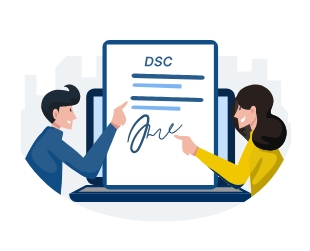
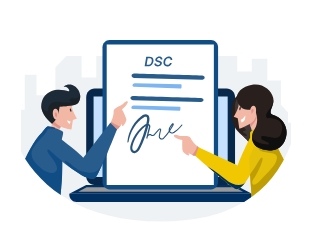
Advantages of a Digital Signature Certificate
In the digital world, DSCs are very useful because they make online processes faster, safer, and more reliable.
Security: DSCs keep your information safe by using encryption, meaning no one can change or mess with your signed documents or transactions.
Legal Acceptance: Just like signing a paper document with a pen, DSCs are legally recognized for signing contracts, filing taxes, and following regulations in many places.
Saves Time and Paper: With DSCs, there's no need to print, sign, and mail documents. You can sign and send them online, saving time and reducing the use of paper.
Trustworthy: A DSC shows that the person signing a document is really who they say they are. This builds trust in online transactions and agreements.
Clear Record: DSCs provide a digital record of who signed a document and when, making it easier to track and ensure responsibility in business and legal dealings.
DSCs are important tools that make online activities like signing documents or completing transactions faster, safer, and more efficient in our increasingly digital world.
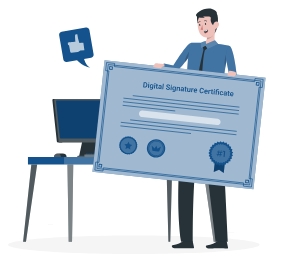
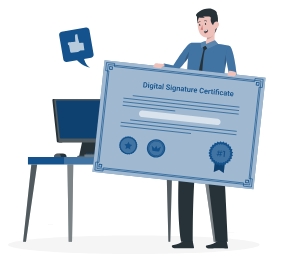
Importance of DSC for Fulfilling Statutory Compliances
A Digital Signature Certificate (DSC) is essential for meeting various statutory and regulatory requirements mandated by government authorities.
Income Tax Filing:
Individuals and entities whose accounts are subject to audit under the Income Tax Act must mandatorily file their Income Tax Returns (ITR) using a DSC. It ensures secure submission and authentication of tax documents.
Ministry of Corporate Affairs (MCA):
The MCA requires all companies to file statutory documents, forms, and returns (like DIR-3, AOC-4, MGT-7, etc.) digitally using a valid DSC. This ensures data integrity and legal compliance in company filings.
Goods and Services Tax (GST):
For companies and LLPs, GST registration and subsequent filings (such as GSTR-1, GSTR-3B, refund applications, and amendments) must be authenticated using a DSC. It verifies the identity of the authorised signatory and secures the transaction.
Import and Export (DGFT):
Businesses dealing with international trade must use a DSC for filing applications with the Director General of Foreign Trade (DGFT), such as obtaining an Import Export Code (IEC), filing licensing applications, and other related services.
Employees’ Provident Fund (EPFO):
Employers are required to use a DSC for filing returns, transferring funds, and approving KYC details of employees on the EPFO portal.
E-Tendering and E-Procurement:
Government and public sector undertakings mandate the use of DSCs for participating in e-tendering processes, submitting bids, and signing contracts electronically.
Certifying Authorities for Issuance of a Digital Signature Certificate
The Controller of Certifying Authorities (CCA), operating under the Ministry of Electronics and Information Technology (MeitY), Government of India, is the regulatory body responsible for overseeing the issuance and management of Digital Signature Certificates (DSCs) in India.
To facilitate this, the CCA has licensed multiple Certifying Authorities (CAs) to issue DSCs to individuals, businesses, and government entities. Currently, 15 authorised Certifying Authorities are recognised for this purpose.
These CAs are entrusted with the task of verifying applicant identity and issuing DSCs in compliance with the guidelines laid down under the Information Technology Act, 2000.
A list of licensed Certifying Authorities, along with their official websites, is given here.
Types of Digital Signature Certificates (DSC)
These different DSC types ensure security and authenticity across a range of government and business applications, helping individuals and organizations stay compliant with India's legal frameworks for digital transactions.
Class 1 DSC
General Use Cases: Class 1 Digital Signature Certificates are issued for both business professionals and private individuals. These certificates confirm that the subscriber's information in the application does not conflict with data in recognized consumer databases. Class 1 DSCs are suitable for securing basic personal digital interactions, such as email authentication and low-risk transactions.
Class 2 DSC
Uses for Business Personnel: Class 2 DSCs are mainly used by business professionals for filing documents with government bodies such as the Registrar of Companies (ROC), Income Tax Return (ITR) filings, and MCA forms. In this class, the identity of the individual is verified against a trusted, pre-verified database, ensuring a moderate level of security. Applications include filing tax returns, company incorporation, and audit reports.
Class 3 DSC
High-Value Transaction Applications: Class 3 DSCs offer the highest level of security and are used for high-value transactions. To obtain a Class 3 DSC, individuals must present themselves before a Registration Authority (RA) to verify their identity in person. These certificates are commonly used for e-tendering, e-bidding, e-procurement, and compliance with ROC, GST, IEC registration, and other sensitive online processes that require robust security.
Who Is Eligible for DSC Registration in India?
Digital Signature Certificates (DSCs) can be issued to individuals, organizations, and even foreign applicants. The eligibility for DSC registration in India depends on the purpose of use, whether for personal, company, or government-related activities.
Eligibility Criteria for Individuals
Eligibility: Individuals can apply for a DSC for personal use or to fulfill legal and regulatory requirements. For example, individuals may need a DSC for e-verification of returns or signing digital documents. Professionals such as doctors, lawyers, and accountants can also use DSCs for various compliance purposes.
Common Use Cases: Personal digital transactions, signing e-forms, and tax return filings.
Eligibility Criteria for Organizations
Eligibility: Organizations, including companies, partnership firms, LLPs, NGOs, and proprietorships, can apply for a DSC. Directors, managers, company secretaries, and authorized signatories within these entities are often required to obtain a DSC to sign documents on behalf of the organization.
Common Use Cases:E-filing of ITR , regulatory compliance with SEBI, and ROC filings.
Eligibility Criteria for Foreign Applicants
Eligibility: Foreign nationals and entities conducting business in India can apply for a DSC. They must follow additional documentation requirements, including passport and residency details, for verification.
Common Use Cases: Business transactions and compliance filings within Indian jurisdictions.
Who Requires a DSC?
Directors, managers, and secretaries of companies: This includes public, private, and unlimited companies.
Authorized signatories: Necessary for digitally signing official e-forms.
Regulatory authorities: DSCs are required for signing legal and compliance-related documents for bodies like tax authorities and SEBI.
Documents Required for Digital Signature Registration
When applying for a Digital Signature Certificate (DSC), certain documents are required for identity verification. The list of required documents may vary slightly depending on whether the applicant is an individual, organization, or foreign entity. Below is a comprehensive list of the documents typically needed for DSC registration.
Initial Registration Documents
By ensuring these documents are in place, the DSC registration process can be completed smoothly for individuals, businesses, and foreign applicants alike.
1. Government-Issued ID (Identity Proof):
Aadhaar Card (eKYC Service),
Passport
PAN Card
Driving Licence
Post Office ID Card
Photo ID card issued by the Ministry of Home Affairs or Centre/State Governments
Bank Account Passbook containing the applicant’s photograph, signed and attested by a bank official
2. Address Proof:
Aadhaar Card
Voter ID Card
Driving Licence
Registration Certificate (RC)
Telephone Bill
Water Bill
Bank Account Passbook/Statement
3. Passport-Sized Photograph:
A recent passport-sized photograph is required for all applicants.


How to Apply for a Digital Signature Certificate?
Applying for a Digital Signature Certificate (DSC) in India is a straightforward process. Follow the steps below to complete the registration:
Step 1: Visit the Certifying Authority’s Website
Go to the website of a licensed Certifying Authority (CA) in India. There are around 15 authorized CAs that issue DSCs, such as e-Mudhra, Sify, or NSDL.
On the homepage, navigate to the DSC application section and select the appropriate class (Class 1, Class 2, or Class 3) based on your needs.
Step 2: Fill Out the Application Form
Choose the class of DSC and its validity period (1 to 3 years).
Enter your personal details, such as name, email ID, and contact information. If applying for a business, ensure the relevant business details are also included.
Ensure that all information matches your official identity proof documents.
Step 3: Upload Required Documents
Submit proof of identity and address such as your Aadhaar Card, PAN Card, or Passport. For organizations, submit the Certificate of Incorporation and an Authorization Letter.
Upload a passport-sized photograph and complete the form by e-signing the declaration.
Step 4: Make Payment
Pay the applicable fee based on the class of DSC and its validity. Payment can be made online through net banking, debit/credit cards, or other accepted methods on the CA’s website.
Step 5: Identity Verification
Your identity will be verified via a physical or video-based verification process, depending on the Certifying Authority's policies. In some cases, you may need to present yourself before the Registration Authority (RA) for Class 3 DSC.
Step 6: Issuance of DSC
Once the verification is complete, the Certifying Authority will issue your Digital Signature Certificate. You will receive the DSC either as a file for download or on a USB token (also called a USB e-token) for installation.
Step 7: Download and Install DSC
Download your DSC from the CA’s website. If your DSC is on a USB token, install the required drivers and follow the installation instructions.
Ensure the USB token is securely stored and accessible for future use.
Digital Signature Certificate Renewal
As per the guidelines of the Controller of Certification Agencies (CCA), renewing your DSC online requires fresh identity verification. You can easily renew your Digital Signature Certificate by following the same process as applying for a new DSC on the Charter 24 website.


Your trusted partner for business registration, legal, and tax compliance in India.
Important Links
About us
Careers
Corporate Office
B-23, Krishna Plaza, Second floor, Sarai Khwaja, Faridabad 121003
+91 9870142701
Connect.chartered24@gmail.com
© 2026 Chartered24
Client Testimonials
ICAI
ICSI
ICWI
GST
Income Tax
MCA
Registration
EXPERTISE
Business License
GST
Income Tax
Startup India
MSME
Trademark
Corporate Compliance
& More