
FSSAI Registration Online Obtain FSSAI Registration Certificate
FSSAI Registration is the primary type of registration for the Food Business issued by the FSSAI. We help you to obtain FSSAI Registration and file an application to the FOSCOS Portal on your behalf. Call us for assistance.
Why Choose Us
FSSAI filing guided by Chartered Accountants
Correct license selection (Basic / State / Central)
Compliance-ready documentation & declarations
Food business–specific compliance advice
Support for renewals, modifications & returns
Single-point professional support end-to-end
Overview
Every food business in India, whether a small vendor or a large manufacturer, is legally required to complete FSSAI Registration online and obtain a food license to ensure food safety and consumer trust. FSSAI registration is mandatory for anyone involved in the production, processing, packaging, distribution, or sale of food. From home-based food entrepreneurs to established restaurants and food importers, every food business operator must comply with FSSAI guidelines. Ignoring this requirement can lead to heavy penalties or business closure.
What is FSSAI Registration?
FSSAI Registration is a compulsory authorisation for individuals or entities involved in the manufacturing, processing, storage, distribution, or sale of food products in India. It is governed by the Food Safety & Standards (Licensing and Registration of Food Business) Regulations, 2011. This registration differs from an FSSAI License based on the size and nature of the business.
Importance of FSSAI Registration
FSSAI License registration is vital for all Food Business Operators (FBOs), including those planning to open restaurants, bakeries, hotels, cloud kitchens, or food stalls. It is required for anyone engaged in the manufacturing, preparation, sale, transportation, distribution, or storage of food products. FSSAI registration ensures food safety compliance and enhances your business's reputation.
The Food Safety and Standards Act, 2006 (India)
This act establishes the Food Safety and Standards Authority of India (FSSAI) and regulates food safety and standards in India. FSSAI registration is mandated under this act for businesses involved in activities like manufacturing, processing, packaging, storage, distribution, and sale of food items.
As per the Food Safety and Standards Act, 2006, it is mandatory for all food business operators to complete FSSAI registration. A FSSAI license is mandatory for every food product business in India, and the food license number is provided post-registration. Irrespective of whether you are a retail, wholesaler, manufacturer, e-commerce seller, or involved in the distribution or transport of food products, FSSAI registration is mandatory. The FSSAI registration application can be filed online by food product business owners through Charter 24.
Benefits of FSSAI Registration
Obtaining FSSAI registration offers several advantages that not only ensure legal compliance but also enhance your business reputation and growth prospects:
Legal Compliance: Ensures your business complies with the Food Safety and Standards Act, 2006, which is mandatory for operating a food business in India.
Improved Consumer Trust: Assures customers that your products meet safety and quality standards, helping build credibility and customer loyalty.
Enhanced Reputation: Demonstrates your commitment to safety and high-quality products, attracting more customers.
Market Access: Many retailers and distributors require FSSAI registration to source products, expanding your business opportunities.
Competitive Advantage: Sets your business apart from competitors who may not meet safety standards, making your products more appealing. International Trade Opportunities: FSSAI registration is essential for exporting food products and meeting international regulatory requirements.
Prevention of Legal Issues: Protects your business from penalties, fines, or shutdowns by ensuring compliance with food safety standards.
Assurance of Product Quality: Regular quality checks ensure safe and consistent food products, reducing the risk of foodborne illnesses.
Access to Resources and Support: FSSAI-registered businesses receive support, workshops, and updates on food safety regulations to stay compliant.
Better Business Opportunities: Opens doors to government contracts, tenders, and partnerships, helping you grow and expand your business.
Eligibility Criteria for FSSAI Registration
To be eligible for food license registration in India under the Food Safety and Standards Authority of India (FSSAI), an individual or entity must meet certain criteria based on the nature and scale of their food business. The eligibility for each type of FSSAI registration Basic Registration, State License, and Central License is determined primarily by the business’s annual turnover and operational reach, here is an outline of the same:
Criteria for FSSAI Basic Registration
FSSAI Basic registration is for small-scale or petty food business operators.
This category covers home-based food entrepreneurs, small vendors, local tea stalls, and small retailers who operate on a limited scale.
The turnover criteria is upto ₹12 lakhs per annum
Criteria for FSSAI State License
FSSAI State License is applicable to medium-sized food businesses.
This covers businesses typically including mid-level manufacturers, food processors, restaurants, and caterers operating within a single state.
The turnover criteria for state license is ₹12 lakhs to ₹20 crores per annum
Criteria for FSSAI Central License
FSSAI Central Licenseis mandatory for large food businesses and those engaged in import and export of food products.
It also applies to food businesses operating in multiple states or supplying food to government institutions such as railways, airports, and defense.
The turnover criteria for central license should be more than ₹20 crores per annum or interstate operations
Food Business Operators Who Require FSSAI Registration?
The Food Business Operators (FBOs) carrying on the following kinds of food business must have an FSSAI License Registration:
Petty retailers, Retail Shops, Snack shops, Confectionery or Bakery shops, etc
Temporary stalls, fixed stalls, or food premises are involved in preparing, storing, distributing, and selling food products.
Hawkers sell packaged or freshly prepared food by traveling from one location to another.
Dairy Units, including Milk Chilling Units, Petty Milkmen, and Milk Vendors
Slaughtering house
Fish Processing, Meat Processing, and unit
All Food Manufacturing units that include Repacking food
Vegetable Oil Processing Units
Proprietary food and Novel food
Cold/refrigerated storage facility
Transporter of food products, having several specialised vehicles like insulated refrigerated vans/wagons, milk tankers, food wagons, food trucks, etc
Wholesalers, suppliers, distributors, and marketers of food products
Hotels, Restaurants, and Bars
Canteens and Cafeteria, including mid-day meal canteens
Food Vending Agencies and Caterers
Dhaba, PG provides food, a Banquet hall with food catering arrangements, Home home-based canteen, and Food stalls at fairs or religious institutions.
Importers and Exporters of food items and food ingredients
E-Commerce food suppliers, including cloud kitchens
Eligibility Criteria for FSSAI Registration
To be eligible for food license registration in India under the Food Safety and Standards Authority of India (FSSAI), an individual or entity must meet certain criteria based on the nature and scale of their food business. The eligibility for each type of FSSAI registration Basic Registration, State License, and Central License is determined primarily by the business’s annual turnover and operational reach, here is an outline of the same:
Criteria for FSSAI Basic Registration
FSSAI Basic registration is for small-scale or petty food business operators.
This category covers home-based food entrepreneurs, small vendors, local tea stalls, and small retailers who operate on a limited scale.
The turnover criteria is upto ₹12 lakhs per annum
Criteria for FSSAI State License
FSSAI State License is applicable to medium-sized food businesses.
This covers businesses typically including mid-level manufacturers, food processors, restaurants, and caterers operating within a single state.
The turnover criteria for state license is ₹12 lakhs to ₹20 crores per annum
Criteria for FSSAI Central License
FSSAI Central Licenseis mandatory for large food businesses and those engaged in import and export of food products.
It also applies to food businesses operating in multiple states or supplying food to government institutions such as railways, airports, and defense.
The turnover criteria for central license should be more than ₹20 crores per annum or interstate operations
Checklist for FSSAI Registration
Before applying for FSSAI registration or license, it’s important to ensure you have all the necessary information and documents ready. Here is a checklist that helps food business operators confirm they meet the basic requirements for a smooth application process.
FSSAI Registration Checklist:
Valid Documents: Ensure you have government-issued identity proof, address proof of the business, and passport-sized photographs of the applicant and key personnel
Food Business Type: Identify the nature of your food business, whether it’s manufacturing, retail, catering, storage, distribution, or a home-based operation
Turnover Bracket: Know your annual turnover to determine whether you need basic registration, state license, or central license
Business Address: Have a fixed and verifiable business location, which is essential for license issuance and inspections
FSSAI Compliance Practices: Be aware of and implement food safety and hygiene practices as per FSSAI guidelines to ensure eligibility and smooth approval.


Types of FSSAI Registration
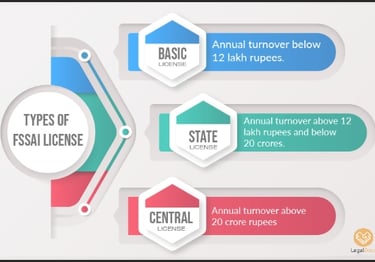
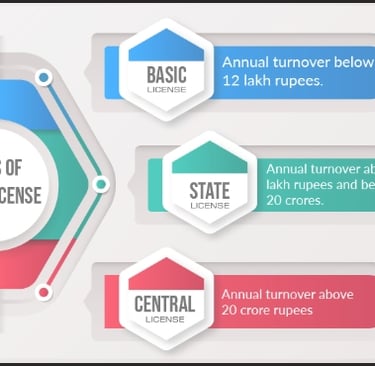
FSSAI registrations are categorised based on a food business’s turnover, production capacity, and other operational details. Businesses must choose from three main types of registrations—Basic, State, or Central—depending on their turnover and production scope. Below is an overview of each registration type and the corresponding eligibility criteria:
FSSAI Basic Registration
Who Needs It: Food Business Operators (FBOs) with an annual turnover of less than INR 12 lakh.
Registration Form: Form A
Key Point: This registration is generally for small-scale or startup food ventures, such as small retailers or home-based food producers.
FSSAI State License
Who Needs It: FBOs with an annual turnover between INR 12 lakh and INR 20 crore.
Registration Form: Form B
Key Point: Medium-sized ventures—like mid-level restaurants, small to mid-scale manufacturers, and distributors—typically require the State License.
FSSAI Central License
Who Needs It: FBOs with an annual turnover exceeding INR 20 crore.
Registration Form: Form B
Key Point: Large-scale food businesses—such as major manufacturers, major retailers, and large distributors—must apply for the Central License.
By choosing the registration/license that aligns with their business size and turnover, FBOs ensure they comply with the regulations laid down by the Food Safety & Standards Authority of India (FSSAI).
Documents for FSSAI Registration
To obtain FOSCOS FSSAI registration , Food Business Operators (FBOs) must submit a set of general and specific documents based on their business type (Basic Registration, State License, or Central License).
General FSSAI Registration documents
These documents are required for all types of FOSCOS FSSAI registrations (Basic, State, and Central):
Photo Identity Proof: Valid ID proof of the FBO (Aadhaar card, passport, voter ID, etc.)
Business Constitution Certificate: Documents such as partnership deed, certificate of incorporation, shop and establishment license, or other business registration certificates.
Proof of Premises Possession: Rental agreement, NOC (No Objection Certificate) from the owner of the rented premises, utility bills, etc.
Food Safety Management System Plan: A detailed plan outlining food safety procedures.
List of Food Products: List of food products being manufactured or processed by the business.
Bank Account Information: Bank account details of the business.
Supporting Documents (if applicable): NOC from Municipality or Panchayat, Health NOC, copy of License from the manufacturer, etc.
Consequences of Non-Compliance with FSSAI Regulations
Food businesses registered under FSSAI are required to follow the rules and regulations outlined in the FSS Act, 2006. A Food Safety Officer typically conducts inspections of the business premises to assess compliance with these regulations, using a checklist. Based on the inspection, the officer may classify the business as:
Compliance (C)
Non-compliance (NC)
Partial compliance (PC)
Not applicable/Not observed (NA)
If non-compliance is identified, the officer may issue an improvement notice as per Section 32 of the FSS Act, 2006. Failure to comply with the notice may result in the cancellation of the registration after the operator is given an opportunity to explain their actions.
Validity of FSSAI Registration
The validity of an FSSAI registration depends on the type of license granted. Typically, FSSAI registration is valid for either 1 year or 5 years, based on the business's eligibility and size.
FSSAI Registration Renewal
FSSAI registration renewal is a crucial process for Food Business Operators (FBOs) to continue operating legally. Since the FSSAI registration or license is granted for a validity period of 1 to 5 years based on the business type, it is mandatory for FBOs to apply for renewal before the expiry date. Timely FSSAI registration renewal—preferably 120 days prior to expiry—helps avoid any legal complications, penalties, or disruption in business operations.
FSSAI Registration Fees
FSSAI Registration Fees depend on the type and scale of your food business. Different categories of registration—Basic, State, or Central—have varying fees based on the size and turnover of the business. The fees cover the cost of processing your application and issuance of the registration or license.
Procedure for Obtaining FSSAI Registration Online
Food Business Operators (FBOs) can easily apply for FSSAI new registration through the official FoSCoS portal by following the steps below:
Step 1: Visit the FoSCoS Portal
Go to the FoSCoS portal to begin the registration process.
Step 2: Choose the Appropriate Form
Select and fill out Form A (for Basic Registration) to get started with your FSSAI registration online.
Step 3: Upload Required Documents:
Submit the necessary documents online along with the application.
Alternatively, documents can be submitted physically if applying offline.
Step 4: Application Review:
The Food Safety Department will review the application. The application will be either accepted or rejected within 7 days of submission.
If rejected, the applicant will be informed in writing.
Step 5: Premises Inspection (if required)
The Department may conduct an inspection of your food business premises.
Step 6: Issuance of FSSAI Registration Certificate
If the application is approved, the Department issues the FSSA certificate.
The FSSAI certificate includes a registration number and the applicant’s photograph.
It will be sent via email and can also be downloaded from the FoSCoS portal.
Step 5: Display the FSSAI Certificate
The FSSAI Registration certificate must be displayed prominently at the business premises during business hours.


Your trusted partner for business registration, legal, and tax compliance in India.
Important Links
About us
Careers
Corporate Office
B-23, Krishna Plaza, Second floor, Sarai Khwaja, Faridabad 121003
+91 9870142701
Connect.chartered24@gmail.com
© 2026 Chartered24
Client Testimonials
ICAI
ICSI
ICWI
GST
Income Tax
MCA
Registration
EXPERTISE
Business License
GST
Income Tax
Startup India
MSME
Trademark
Corporate Compliance
& More